Arctic Winter Sea Ice Suffers Its Largest Annual Drop in the Satellite Record
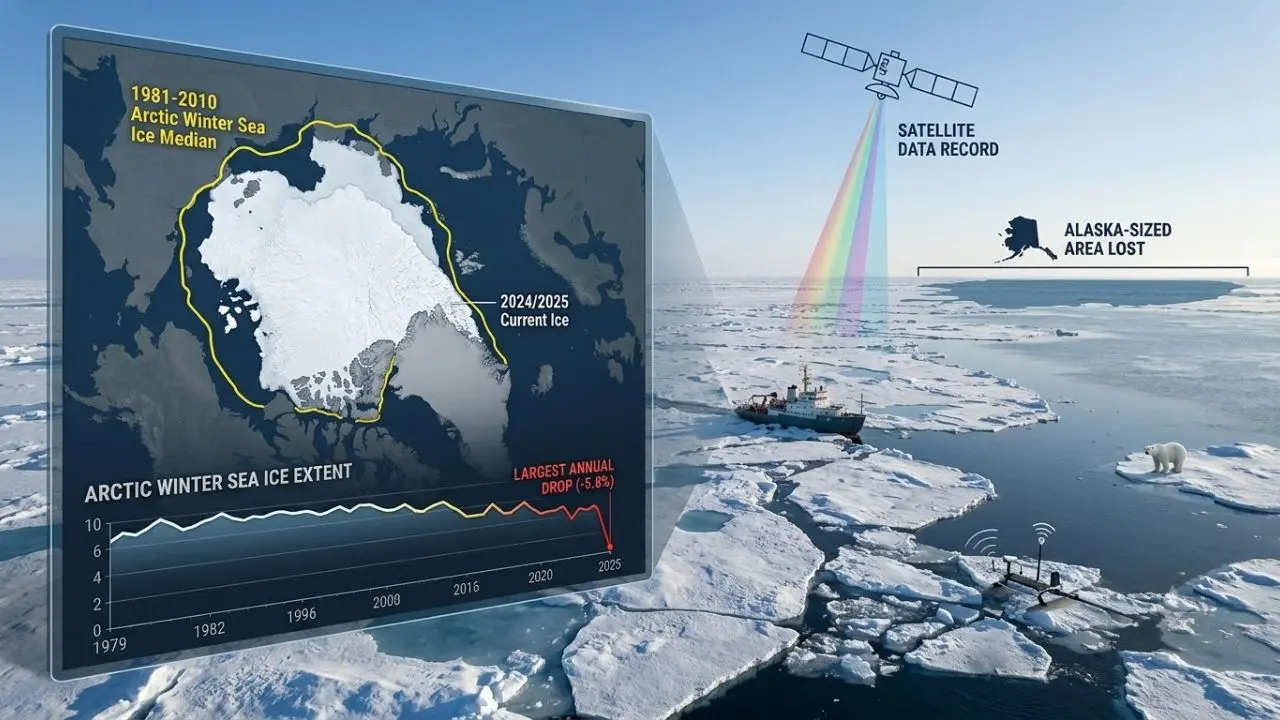
Arctic sea ice has returned to a statistically significant decline after nearly two decades in which the pace of loss appeared to slow.
A new study found that unusually low ice levels during the winters of 2025 and 2026 brought an apparent pause to an end, reinforcing the long-term trend linked to rising global temperatures.
The research, published July 20, 2026, in the journal Proceedings of the National Academy of Sciences, was conducted by scientists from the University of Southampton and the United Kingdom’s National Oceanography Centre.
According to the researchers, the slowdown seen during the previous two decades did not represent a permanent recovery. Instead, it was a temporary fluctuation within a much broader pattern of Arctic ice decline.
Arctic Sea Ice Fell 5.8% During the Winter Peak
Between 2024 and 2025, the average extent of Arctic sea ice during February and March, when winter coverage is near its annual peak, fell by 5.8%.
The University of Southampton described it as the largest year-to-year decline for that measurement since continuous satellite observations began in late 1978.
Sea ice extent measures the area of ocean where at least 15% of the surface is covered by ice. The 5.8% decline does not mean the Arctic lost the same percentage of its total ice volume or frozen mass in a single year.
Average winter ice coverage increased slightly in 2026 compared with 2025. Even so, it remained the second-lowest level in the data examined by the research team.
Together, the two winters marked an abrupt shift away from the relatively stable conditions observed during parts of the previous two decades.
The 2025 and 2026 Winter Maximums Were Effectively Tied
Daily measurements of the annual winter maximum also showed that Arctic sea ice remained at exceptionally low levels.
On March 22, 2025, sea ice reached approximately 5.53 million square miles, or 14.31 million square kilometers. At the time, it was the lowest winter maximum ever recorded.
On March 15, 2026, the maximum was measured at approximately 5.52 million square miles, or 14.29 million square kilometers.
Although the 2026 figure was slightly lower, NASA and the National Snow and Ice Data Center consider the two records statistically tied.
The NSIDC treats measurements separated by no more than about 15,400 square miles, or 40,000 square kilometers, as equivalent because of uncertainty in satellite estimates. The difference between the 2025 and 2026 maximums was only about 7,700 square miles, or 20,000 square kilometers.
The 2026 winter maximum was roughly 525,000 square miles, or 1.36 million square kilometers, below the average recorded from 1981 to 2010.
That missing ice-covered area was about twice the size of Texas.
The So-Called Pause Never Meant the Ice Had Stopped Disappearing
The idea of a pause developed because the rate of Arctic sea ice decline slowed across several seasons and measurements for approximately 20 years.
A 2025 study published in Geophysical Research Letters found that the September minimum had not shown a statistically significant decline since 2005, even though global temperatures continued to rise.
September is especially important because it is when Arctic sea ice usually reaches its lowest point after the summer melting season.
The researchers concluded that natural climate variability had temporarily offset part of the ice loss caused by long-term warming. They also warned that the decline could accelerate again once those short-term conditions changed.
That appears to be what happened.
After adding the exceptionally low values from 2025 and 2026, a team led by researcher Duo Chan found that 20-year trends once again showed a statistically significant reduction in Arctic sea ice.
The findings suggest that the earlier slowdown was never evidence that the Arctic had stabilized. It was a temporary interruption inside an ongoing long-term decline.
Climate Models Suggest the Arctic Has Shifted to a Lower Level
The research team compared satellite observations with similar events simulated in climate models.
The sharp decline recorded in 2025 was unusual, but the models showed that it was physically possible under the Arctic’s current warming conditions.
The results indicate that winter sea ice will likely fluctuate around a lower level over the next several years instead of quickly returning to the coverage seen in the early 2020s.
That does not mean every upcoming winter will set a new record.
The Arctic experiences significant natural variability. Winds, ocean currents, air temperatures and regional weather patterns can cause temporary increases or decreases from one year to the next.
A short-term recovery, however, would not erase the broader trend. Scientists warn that individual years can temporarily hide the direction of long-term change, especially in a region as naturally variable as the Arctic.
Less Ice Allows the Ocean to Release More Heat
Winter sea ice acts as an insulating barrier between the relatively warm ocean and the much colder atmosphere above it.
When the ice cover shrinks or becomes thinner, more heat and moisture can escape from the ocean into the air.
This transfer can influence atmospheric pressure, storm development and circulation systems. Some of those effects may extend far beyond the Arctic, although scientists continue to study how Arctic changes interact with weather patterns at lower latitudes.
A NASA Terra satellite image captured on March 17, 2026, showed fragmented ice and large areas of open water in the Barents Sea.
The Barents Sea was one of the regions that contributed to the unusually low Arctic winter maximum that year.
Measurements from NASA’s ICESat-2 satellite also indicated that some of the remaining ice in the Barents Sea was especially thin, making it more vulnerable to breaking apart and melting.
Ice thickness is a critical part of the Arctic climate system. Two years can have similar ice extent while containing very different amounts of total frozen water.
Thin, newly formed ice is generally less resilient than older, thicker ice and is more likely to disappear during warmer conditions.
More Than 95% of the Oldest Arctic Ice Has Already Disappeared
The recent winter decline is part of a transformation that has been unfolding for several decades.
According to NOAA’s 2025 Arctic Report Card, more than 95% of the Arctic’s oldest and thickest sea ice, defined as ice more than four years old, has disappeared since the 1980s.
Older ice can survive multiple summer melting seasons and is generally thicker and more resistant than ice formed during a single winter.
As that older ice has vanished, the Arctic has become increasingly dominated by younger, thinner ice that is more vulnerable to changing temperatures, winds and ocean conditions.
NOAA also reported that the 19 lowest September sea ice minimums in the satellite record occurred during the most recent 19 years.
That pattern shows that even when the rate of decline appears to slow for several years, the Arctic is still operating at levels far below those observed in previous decades.
Why Arctic Sea Ice Matters Beyond the Polar Region
Arctic sea ice plays a major role in regulating Earth’s climate.
Its bright surface reflects a large amount of sunlight back into space. Dark ocean water absorbs much more solar energy.
When ice disappears, more heat is absorbed by the ocean. That additional warming can delay the formation of ice during the fall and contribute to further melting, creating a reinforcing cycle.
Sea ice also affects marine ecosystems, coastal communities, shipping routes and species that depend on frozen habitats.
Changes in the Arctic can influence ocean and atmospheric systems, although the precise impact on specific weather events remains an active area of scientific research.
The new study does not claim that Arctic sea ice will decline at the same rate every year. It shows that short periods of slower loss should not be mistaken for a reversal.
The dramatic reduction between 2024 and 2025, followed by another exceptionally low winter in 2026, ended the appearance of stability.
The latest evidence indicates that Arctic winter sea ice has moved toward a lower baseline, while the long-term effects of global warming continue to reshape one of the most climate-sensitive regions on Earth.