Singapore Is Sinking 10-Story Concrete Giants Into the Sea to Build the World’s Largest Automated Port
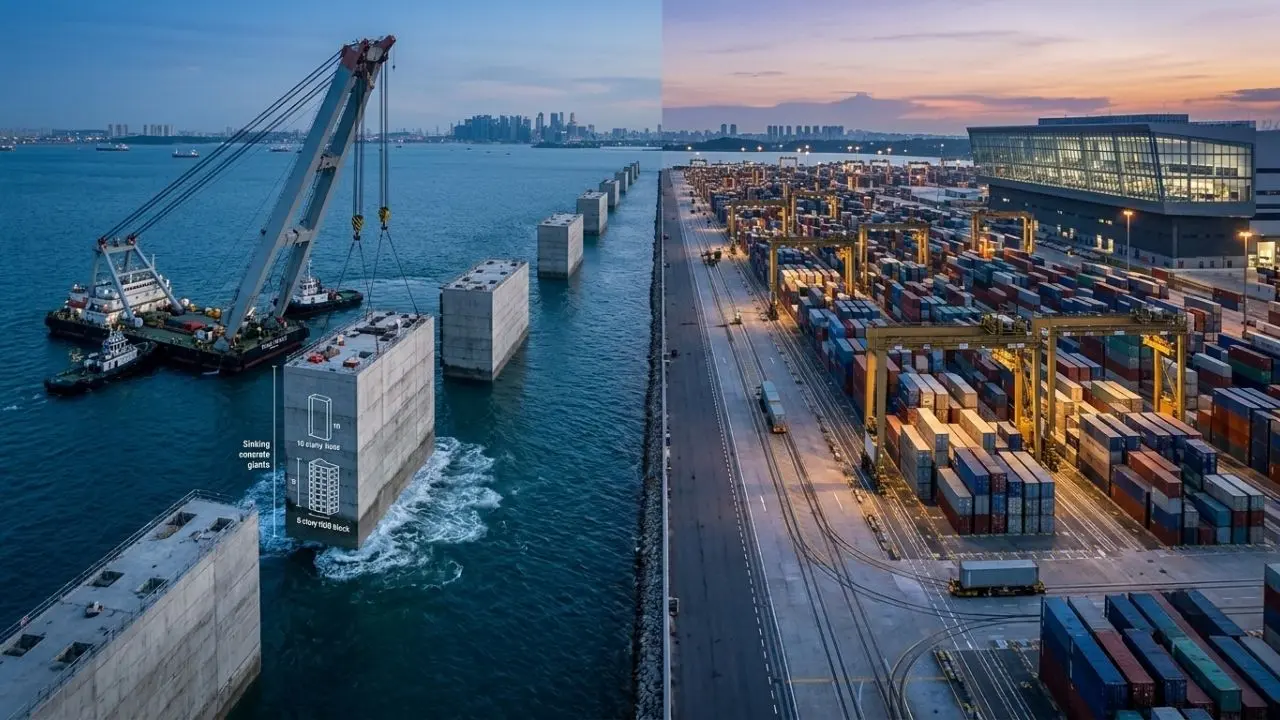
Singapore is transforming a stretch of open water into a massive automated shipping hub designed to handle some of the largest container vessels on Earth.
At the center of the project are hundreds of enormous concrete structures, each roughly as tall as a 10-story building. Known as marine caissons, these engineered units have been positioned along the seafloor to create the retaining walls and future docking areas of Tuas Port.
Once completed in the 2040s, the port is expected to cover about 3,304 acres, an area comparable to roughly 3,300 soccer fields. It will include 66 berths spread across approximately 16 miles of waterfront and will be capable of handling as many as 65 million twenty-foot equivalent units, or TEUs, every year.
The Maritime and Port Authority of Singapore describes Tuas as a next-generation port built around automation, artificial intelligence, electrified machinery and advanced communication systems.
What Is a TEU?
A TEU is the standard unit used to measure container shipping capacity.
One TEU represents the space occupied by a standard 20-foot shipping container. The measurement allows ports, shipping companies and logistics operators to compare capacity even when cargo is being transported in containers of different sizes.
Tuas Port’s planned annual capacity of 65 million TEUs would be nearly twice the 37.5 million TEUs handled by Singapore in 2021.
The scale of the project reflects Singapore’s role as one of the world’s most important maritime transshipment hubs. Many containers arriving in the country are not intended for local delivery. Instead, they are transferred from large vessels to other ships before continuing toward ports across Asia and the rest of the world.
The Concrete Structures Are Not Simply Dumped Into the Ocean
The giant concrete units used at Tuas are often described as blocks, but they are far more sophisticated than ordinary pieces of concrete.
Each marine caisson is a large boxlike structure manufactured to become part of the permanent quay wall. The units are built on land, transported into position, lowered onto specially prepared foundations and stabilized to create a continuous barrier.
During the first phase of the project, engineers installed 221 caissons. Each unit measured about 131 feet long, 92 feet wide and 92 feet tall, making it comparable in height to a 10-story residential building.
Every caisson weighed approximately 15,000 metric tons. Together, the Phase 1 structures formed about 5.3 miles of seawall.
Phase 2 required another 227 caissons of a similar scale. Those structures were used to create an additional 5.7 miles of seawall.
Combined, the first two phases account for approximately 11 miles of concrete maritime infrastructure, although the sections belong to different stages of the overall development.
The Walls Will Support Ships on One Side and New Land on the Other
The caisson walls perform two major functions.
On the seaward side, they form the foundation of the quays where container ships will eventually dock. On the inland side, they retain the material used to create new land in areas that were previously covered by water.
This process is known as land reclamation.
Before an area can be filled, construction teams must prepare and strengthen the seabed. They also dredge and deepen navigation channels so large ships can approach the terminal without their hulls touching the bottom.
The first phase included soil improvement work across approximately 1,023 acres. Of that total, about 726 acres consisted of newly reclaimed land. The project required approximately 34 million work hours and involved more than 450 companies.
The seabed was also deepened to accommodate future generations of larger container ships.
The Port Is Designed for Some of the World’s Largest Ships
Tuas Port’s deepwater berths are designed to serve ships with a draft of up to approximately 69 feet.
A ship’s draft is the vertical distance between the waterline and the lowest point of its hull. The greater the draft, the deeper the water must be for the vessel to navigate safely.
The ability to handle ships with a 21-meter draft will allow Tuas to receive extremely large container vessels that cannot enter shallower ports.
The terminal also uses a finger-pier design. Instead of constructing one uninterrupted line along the coast, sections of the port extend outward into the water.
This configuration increases the amount of available docking space while making it easier to serve ships of different lengths.
Tuas Port Is Being Built in Four Major Phases
Singapore announced its long-term plan to consolidate container operations at Tuas in 2012.
Reclamation work for Phase 1 began in February 2015 and was completed in November 2021. The first two berths started operating in December 2021, while the port was officially opened on September 1, 2022.
When fully operational, Phase 1 is expected to include 21 deepwater berths with an annual handling capacity of 20 million TEUs. Full operation of the first phase is targeted for 2027.
Work on Phase 2 began in March 2018. The second phase covers approximately 956 acres and is designed to add another 21 million TEUs of annual capacity.
By January 2025, 11 berths were operational at Tuas, while reclamation work for Phase 2 was about 75% complete. At that time, authorities said seven additional berths were scheduled to begin operating by 2027.
In March 2026, the Maritime and Port Authority said four more berths would open during the year. One of them will include the Tuas Living Lab, a real-world testing environment for autonomous vehicles and other technologies intended for highly automated port operations.
Phases 3 and 4 will complete the larger complex over the following years. By the 2040s, Singapore plans to consolidate its major container operations at Tuas.
Driverless Electric Vehicles Will Move Containers Around the Terminal
Automation will play a major role in moving cargo between ships, storage yards and loading areas.
Tuas will use electrified automated guided vehicles, commonly called AGVs, to transport containers between the wharf and the container yards.
Unlike conventional terminal vehicles, these machines do not require a driver inside the cab. They follow routes controlled by digital systems and receive instructions based on cargo locations, vessel schedules and terminal traffic.
Automated yard cranes will lift containers between storage stacks and vehicles. Many operations will be supervised remotely from the Tuas Port Control Centre, allowing workers to manage equipment through cameras, sensors, live data and digital alerts.
The system is designed to reduce the number of workers who must remain physically close to extremely heavy moving machinery.
Automation does not mean the port will operate without people. Engineers, maintenance crews, cybersecurity specialists, logistics planners, maritime controllers and safety professionals will still be essential to keeping the terminal running.
A Private 5G Network Will Connect Vehicles and Cranes
PSA Singapore, the company operating the container terminal, plans to deploy a private 5G network at Tuas Port.
The network will support connected automated vehicles and cranes by allowing machines to exchange information with low transmission delays.
That is especially important inside a busy terminal where multiple vehicles may be traveling between the same docks and storage yards at the same time.
Equipment must constantly share information about position, speed, cargo assignments and traffic conditions. A delay of even a few seconds can reduce efficiency or create congestion in high-volume areas.
The 5G system is also expected to support smart-grid technology and future cargo-handling applications.
Artificial Intelligence Will Decide Where Containers Should Go
Moving containers efficiently involves more than transporting them from one location to another.
A poorly positioned container can create significant extra work. When a container needed for immediate shipment is buried beneath several others, cranes may have to move multiple units before reaching it.
Optimization systems can analyze vessel schedules, cargo destinations, equipment availability and storage capacity before deciding where each container should be placed.
Artificial intelligence can also help assign vehicles, predict bottlenecks and choose routes that reduce congestion inside the terminal.
Singapore has also worked on an operational digital twin for automated container operations at Tuas.
A digital twin is a virtual representation of a real system. It receives information from machines, sensors and operational processes, allowing managers to monitor performance and test changes in a simulated environment before applying them to the physical port.
For example, operators could simulate a change in traffic flow, equipment deployment or container storage strategy without interrupting actual terminal operations.
Consolidating Operations Could Eliminate Unnecessary Transfers
Singapore currently operates container facilities in multiple locations.
The long-term plan is to move operations from older terminals and consolidate them at Tuas. Activities from Tanjong Pagar, Keppel and Brani are expected to be transferred first, while operations at Pasir Panjang are scheduled to move during the broader consolidation planned for the 2040s.
Keeping more container operations in a single region could reduce the need to move cargo between separate terminals by road or smaller vessels.
This matters in a transshipment hub where containers may arrive on one ship and leave on another within a limited period.
Reducing unnecessary transfers can shorten travel distances, lower costs and make it easier to coordinate cargo movements between vessels.
Electric Equipment Could Cut Port Emissions
Tuas is also being designed to reduce emissions from equipment operating inside the terminal.
The active berths use electrified quay cranes, yard cranes and automated guided vehicles.
According to the Maritime and Port Authority, electric AGVs can reduce carbon emissions by about 50% compared with the diesel-powered prime movers commonly used at conventional terminals.
PSA has set a goal of achieving net-zero emissions at Tuas Port by 2050.
Its plans include smart-grid management, battery energy storage, electrified equipment and buildings designed to use less energy.
One administrative building at the terminal was designed as a super-low-energy facility. It reportedly consumes 58% less energy than comparable buildings and uses solar generation to offset its electricity use.
These measures apply primarily to machinery, vehicles and facilities controlled by the terminal. They do not eliminate emissions produced by the ships that call at the port.
Tuas Is Already Operating, but Most of the Port Has Yet to Be Built
Tuas Port is not simply a futuristic concept or an engineering proposal.
Ships are already docking there, containers are already being moved and automated equipment is already operating across completed sections of the terminal.
At the same time, most of the planned infrastructure is still under development.
As new berths open, Singapore will gradually expand the systems being tested today, including autonomous transportation, remote crane operations, artificial intelligence and connected port equipment.
When the full complex is completed in the 2040s, it will bring together 66 berths, 26 kilometers of waterfront and enough annual capacity to process 65 million TEUs.
The project shows what happens when land reclamation, heavy marine engineering and digital automation are combined on an enormous scale.
Singapore is not simply expanding an existing harbor. It is creating new land, building miles of quay walls and redesigning how one of the world’s busiest maritime hubs will operate for decades to come.