The Deep-Space Radio Signal That Lasted 72 Seconds and Was Never Heard Again
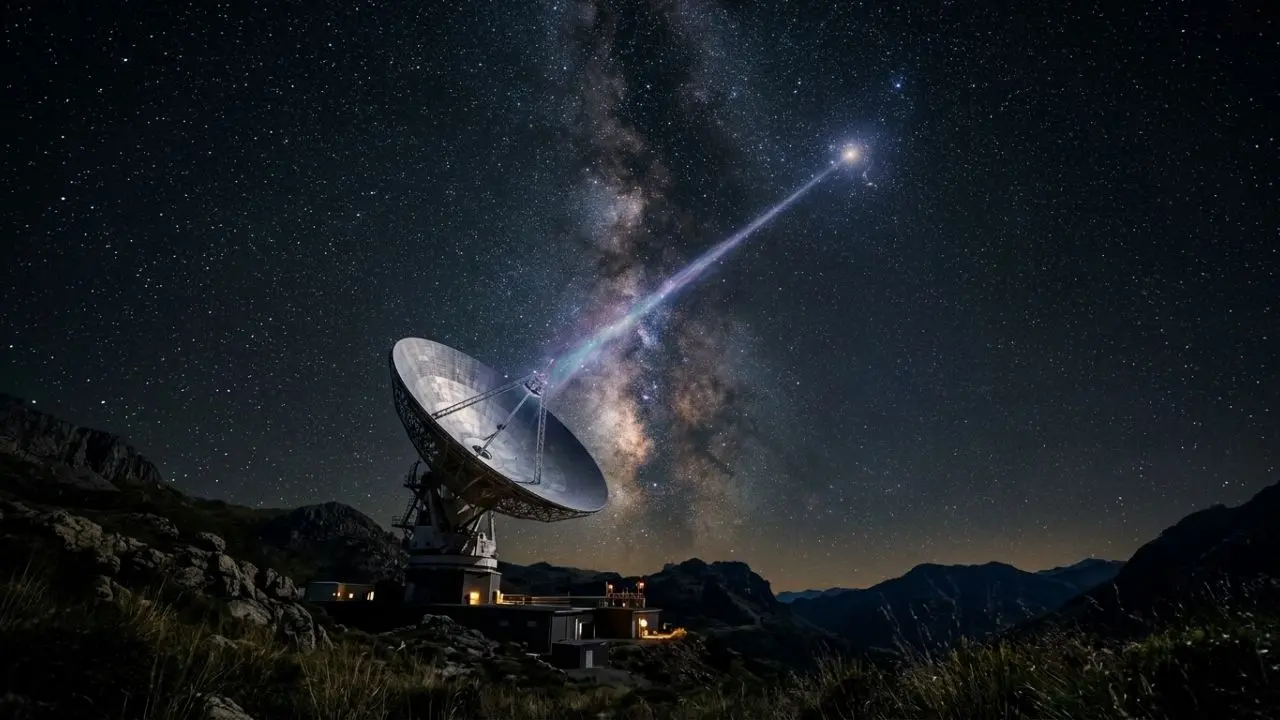
On the night of August 15, 1977, a radio telescope in Ohio picked up an unusually powerful signal from space. The event lasted only 72 seconds, but it would become one of the most enduring mysteries in modern astronomy.
Nearly five decades later, scientists still do not know exactly what produced it.
What Was the Big Ear Telescope Searching For?
The signal was detected by the Big Ear radio telescope, which was operated as part of an Ohio State University project searching for narrowband radio emissions from space.
Unlike traditional telescopes that can be pointed toward different targets, Big Ear remained stationary. As Earth rotated, different sections of the sky passed through the telescope’s observation area.
The incoming data was printed on sheets of paper. Numbers and letters represented the strength of radio waves detected across different frequency channels. Most of the readings showed only minor changes in normal background noise.
One sequence, however, was impossible to overlook.
It read:
6EQUJ5
The characters showed the signal rapidly increasing in strength, reaching an unusually high peak and then gradually fading.
Why Did the Signal Last Exactly 72 Seconds?
The 72-second duration was not random.
That was approximately how long a fixed point in the sky would remain inside the most sensitive portion of Big Ear’s radio beam as Earth rotated. The signal’s rise and fall closely matched the pattern scientists would expect from a distant source passing through the telescope’s field of view.
Several characteristics made the detection especially unusual:
- The signal was concentrated within a very narrow frequency range.
- Its strength followed the expected response pattern of the telescope.
- It appeared to come from the general direction of the constellation Sagittarius.
- Its peak was far stronger than the surrounding background noise.
- It was not detected by the telescope’s second beam when the same area of sky was observed minutes later.
That final detail became one of the greatest obstacles to identifying the source. If the transmission had continued, the second beam should have detected it as well.
How the “Wow!” Signal Got Its Name
Astronomer Jerry Ehman, who was volunteering at the observatory, reviewed the printed data several days after the observation.
When he noticed the unusual sequence, he circled “6EQUJ5” in red ink and wrote a single word beside it:
Wow!
The spontaneous reaction became the permanent name of the event.
Despite decades of speculation, the sequence itself was not a coded message. Each character represented a different level of signal intensity.
The letter “U,” located near the peak of the sequence, indicated an extremely powerful reading. On the scale used by the telescope, it was roughly 30 times stronger than the baseline level represented by the number 1.
Why the Frequency Attracted So Much Attention
The signal was recorded near 1420 megahertz, close to the natural radio frequency emitted by neutral hydrogen. This frequency is commonly known as the 21-centimeter hydrogen line.
Hydrogen is the most abundant element in the universe, making this part of the radio spectrum scientifically important. Researchers involved in the search for extraterrestrial intelligence have long considered it a logical frequency for interstellar communication.
The reasoning is straightforward. Any technologically advanced civilization studying radio astronomy would probably recognize the hydrogen line as a universal reference point.
Still, a signal appearing near that frequency does not prove that it was artificial. Natural astronomical objects can also produce radio emissions in or near the same part of the spectrum.
What Scientists Know About the Detection
The historical record provides several important clues, but each one comes with limitations.
The 72-second observation matched the time required for a celestial source to cross the telescope’s beam. However, that does not reveal how long the source was actually transmitting.
The apparent direction placed the signal in the region of Sagittarius, an area containing numerous stars and other galactic radio sources. The original equipment, however, could not determine its location with extreme precision.
Most importantly, the signal has never been confirmed again.
A 2025 reanalysis of preserved data from the Ohio project proposed revised estimates for the signal’s location, strength and frequency. Researchers placed the frequency at approximately 1420.726 MHz and argued that an astrophysical explanation may be possible.
The new analysis did not solve the mystery. The precise physical process that could have created the signal remains unconfirmed.
Why Repetition Matters
In science, an extraordinary detection must be repeated before researchers can determine what it represents.
If the signal came from an artificial transmitter, astronomers would want to detect it again, confirm its location and study any changes in frequency, intensity or timing. Those details could help separate a technological transmission from natural activity or human-made interference.
Scientists have returned to the same region of the sky several times, but the original signal has never reappeared.
In 2022, observations involving the Green Bank Telescope and the Allen Telescope Array searched for possible technological signals connected to a target in the region. No convincing technosignatures were found.
Without another detection, scientists cannot independently verify the source or determine whether the signal was natural, artificial or the result of an unusual form of interference.
Was It a Message From an Alien Civilization?
There is no evidence proving that the Wow! Signal came from extraterrestrial intelligence.
The SETI Institute describes it as a powerful narrowband signal whose behavior was consistent with a fixed source in the sky. However, because it appeared only once, its true nature could not be established.
The event remains significant because it had several characteristics researchers associate with a potentially interesting celestial radio source. At the same time, a single observation is not enough to claim contact with another civilization.
What Is the Most Likely Explanation Today?
The Wow! Signal remains officially unexplained.
One recent hypothesis suggests that a cold cloud of hydrogen may have briefly released an intense radio emission after being stimulated by a sudden burst of radiation from an energetic astronomical object.
Such an event could potentially produce a strong, narrow signal near the hydrogen frequency without requiring an artificial transmitter.
The idea provides a possible natural explanation, but researchers still need additional observations and evidence to confirm that such a mechanism can reproduce everything detected in 1977.
For now, the Wow! Signal remains exactly what it has been for almost half a century: a genuine, measurable event with no confirmed source.
It appeared for 72 seconds, disappeared and has never been heard again.